Strategic Planning
Long before any code was committed, we conducted a lengthy series of research exercises, prototypes and client meetings. Conversations centered around project goals, user personas, comparable projects and the kind of site we needed to build.
Technical Architecture
LawHelpMN wanted a legal “triage” application, which users could use to help with specific legal issues. But how would this work? We needed to talk through and visualize the tool first. Our technical architect worked on a series of flowcharts and content models, defining the various taxonomies, paths, and requirements for this complex tool. Thanks to the charitable nature of the project, we were even able to converse with developers of triage tools in other states.
UX and Content Strategy
While technical planning was underway, other members of our team began to work on an improved user experience and content strategy. The first goal was to simplify the site navigation and messaging, making their choices clearer to end users. Unused or redundant links and content were eliminated, while relevant content was presented in easier to understand options alongside specific legal topics.
We emphasized plain-language and clarity for end users, making link choices easy to quickly understand and content easier to scan. Our team studied similar tools and websites in other legal aid websites for ideas and best-practices, and documented results for the client.
Responsive and Accessible Design
The design itself was reworked to be clean and clear. The general idea was to get out of the way of users, and keep sharp, simplified design elements in the background. A critical portion of the site's users may be coming to the website in a legal crisis, and the last thing they need is a confusing, slow-loading or overly designed interface.
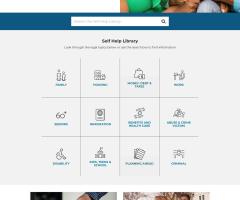
The self-help library is presented in an easy-to-read grid, with simple but effective icons. Defining a single icon for sensitive or ambiguous legal topics was a challenge.
For example, we wanted abuse victims to quickly find the category they require, while not presenting an image that could offend or trigger negative emotions. Having the icons, however, provided a quick visual clue to help users of varying degrees of literacy and knowledge of legal terms. We worked with the client to redefine and narrow categories to more relevant (and fewer) titles.
The triage tool takes a similar approach of minimal design, as do the handful of static web pages and contact forms. All pages and web components are responsive to a range of device and screen sizes.
The LawHelp identity is represented through their logo and color palette, while making small, necessary adjustments to ensure proper contrast for meeting WCAG accessibility requirements.
Online Applications
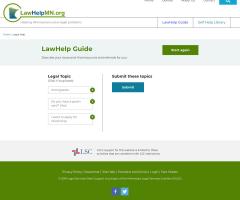
The biggest new feature is the “triage” tool, called the “Legal Help Guide.” This React.js-powered online tool guides users through a series of questions to find the legal aid they need, either through online resources or a direct referral to a service or clinic in their county.
We worked with the client to map the options and define the complex logic trees which power the tool. The client has the ability to update the database without code, and the logic tree is updated upon save.
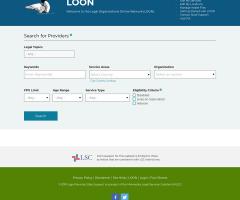
Another great new feature is the Legal Organizations Online Network (LOON). For statewide providers of legal services, the new online tool lets them search across all registered providers, filtering across categories such as legal topics, FPG limit, age range, and service type. Legal organizations now have a central source of information, connecting their clients with the appropriate services for their legal issue.