Authored on
Article
Title

Your Site Search May Be Failing Your Visitors

Subheader

What AI-powered search does differently

Featured Image
Young businesswoman frowning while using a laptop in a modern office
Sections

Good site search has always been hard to get right. Think about the search box on your website. Someone types a few keywords, hits enter, and lands on a results page. How good is that experience? When was it last reviewed? And how many of your visitors gave up on it and went back to Google instead?

The available tools range from bad to slightly-less-bad, and none of them have ever matched what people get from Google every day. So your visitors learned not to bother — which means the content and services you worked hardest to publish are often the ones nobody can find.

Expectations Have Already Changed

You’ve probably used ChatGPT, Claude, or Gemini to find something. Your partners, customers, and constituents have too — and that number climbs every month. Their expectations for what a search box should do have already changed.

Old keyword search matches strings. AI search understands intent. Ask a question the way you’d ask a person, and it reads the meaning behind the words, forgives your typos, and returns the answer — not a wall of blue links to dig through.

In practice, that means:

  • Conversational queries — visitors ask full questions in plain language and get a direct, readable answer
  • Typo and grammar tolerance — misspellings and awkward phrasing no longer break the search
  • Context-aware relevance — results reflect what someone meant, not just the keywords they happened to use
  • Summarized answers — instead of ten links, search surfaces the answer and points to the source

For a large, content-rich site — a city, a university, a statewide nonprofit — the difference is enormous. Every page you publish becomes findable, and your visitors stop leaving to search somewhere else.

Why the Current Options Disappoint

If you want AI search on your site today, you have two paths, and both have problems.

  • Build it yourself — A do-it-yourself system means a large upfront investment, the in-house expertise to architect it correctly, and the ongoing burden of maintaining and improving it as the technology moves. For most organizations, that’s not realistic.
  • Buy a third-party tool — Services like SearchStax and Algolia have improved on default CMS search for years, mostly through better keyword matching, autocomplete, and fuzzy search. Now they’re adding “AI modes” at their highest price tiers. For a mid-sized organization, that can run $800 or more per month — and the setup and tuning are still your problem.

Both paths leave you paying premium prices to operate complex infrastructure you’d rather not think about.

What to Look For in AI Site Search

Whatever you choose, public-sector and mission-driven organizations should hold AI search to a higher standard than a typical commercial site:

  • Answers only from your content — the AI should never pull from the open internet or make things up, and it should say so when your site doesn’t have the answer
  • Links to the source — every summary should point to the page it came from, so visitors can verify
  • Clear data handling — know which AI provider processes your content and whether it’s used to train their models
  • Accessibility — the search and chat interface should meet WCAG 2.2 AA, with full keyboard and screen reader support
  • Someone accountable for it — AI search needs ongoing tuning as your content and the underlying models change; decide up front who owns that work
A Better Way
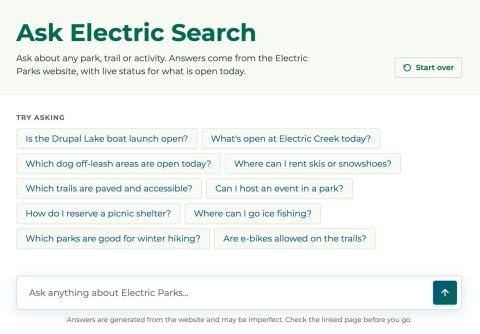
sample page of Electric Search

We built Electric Search to meet that standard. 

It’s our own AI-powered site search: designed around Drupal content structure, answering only from your content, and fully managed by our team — models, infrastructure, tuning, and upgrades — for one predictable monthly fee.

Electric Search is now launching with a small group of pilot clients. Learn more about Electric Search and current pricing, and request a demo.

About the Author

About the author

headshot of Dan

Dan Moriarty is the co-founder, CEO and chief strategist with Electric Citizen.